Drywall Repair in Columbia Heights, MN
Cracked plaster, ceilings marked by ice-dam leaks, and the holes left after new wiring or windows, repaired and textured so the patch settles into the wall around it.
Describe the damage once; a local pro rings back to arrange your quote.
Call 7 days, 7am–9pm Text us a photo
Dust control starts at the doorway.
Room prep: floors covered, doorways sealed
Most of the mess in a wall repair is dust. A proper job plans for it before the first cut.
Floor cover
Canvas or rosin paper covers the floor, taped at the edges so it stays put. Anything close to the wall gets pulled away or wrapped.
Vents and doorways
Supply and return vents in the room get covered, so dust doesn't ride the furnace through the house. A doorway can be hung with plastic.
Sanding
This is where dust spreads. Ask whether the pro sands with a vacuum attached or finishes with a damp sponge. Both keep the air far cleaner.
Old plaster makes more dust than drywall when it is cut. Older house? Worth noting when you phone.
When the quote comes, ask what tidying up it covers. A finished repair should leave a swept floor and a patch ready for paint.
Each has its own page.
The work: four repairs, done one wall at a time
Cracks in plaster and board
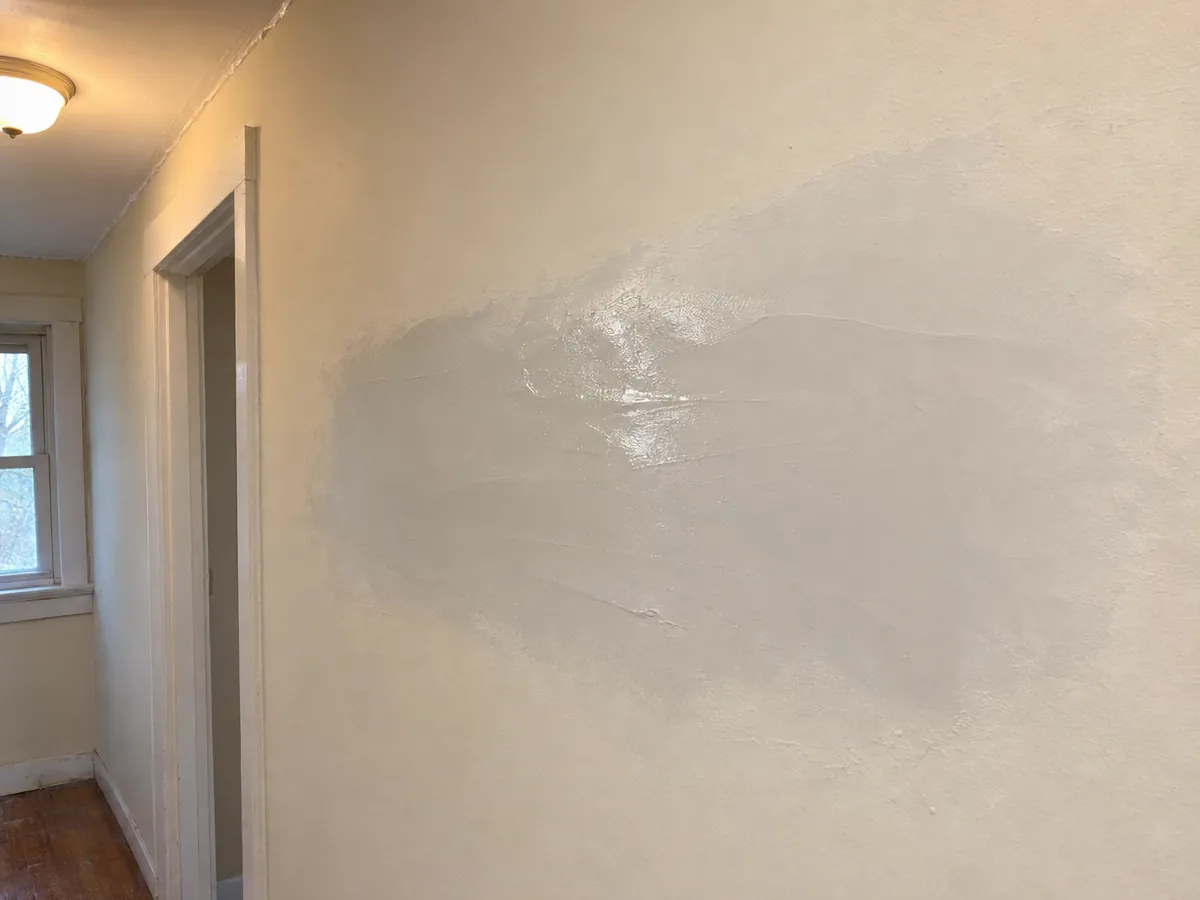
Seasonal cracks in old plaster and split drywall seams, opened, taped and filled flat.
Plaster and drywall crack repair in Columbia HeightsCeilings after a roof leak
Stained, bubbled or soft ceilings after a winter leak, dried out, cut back and rebuilt.
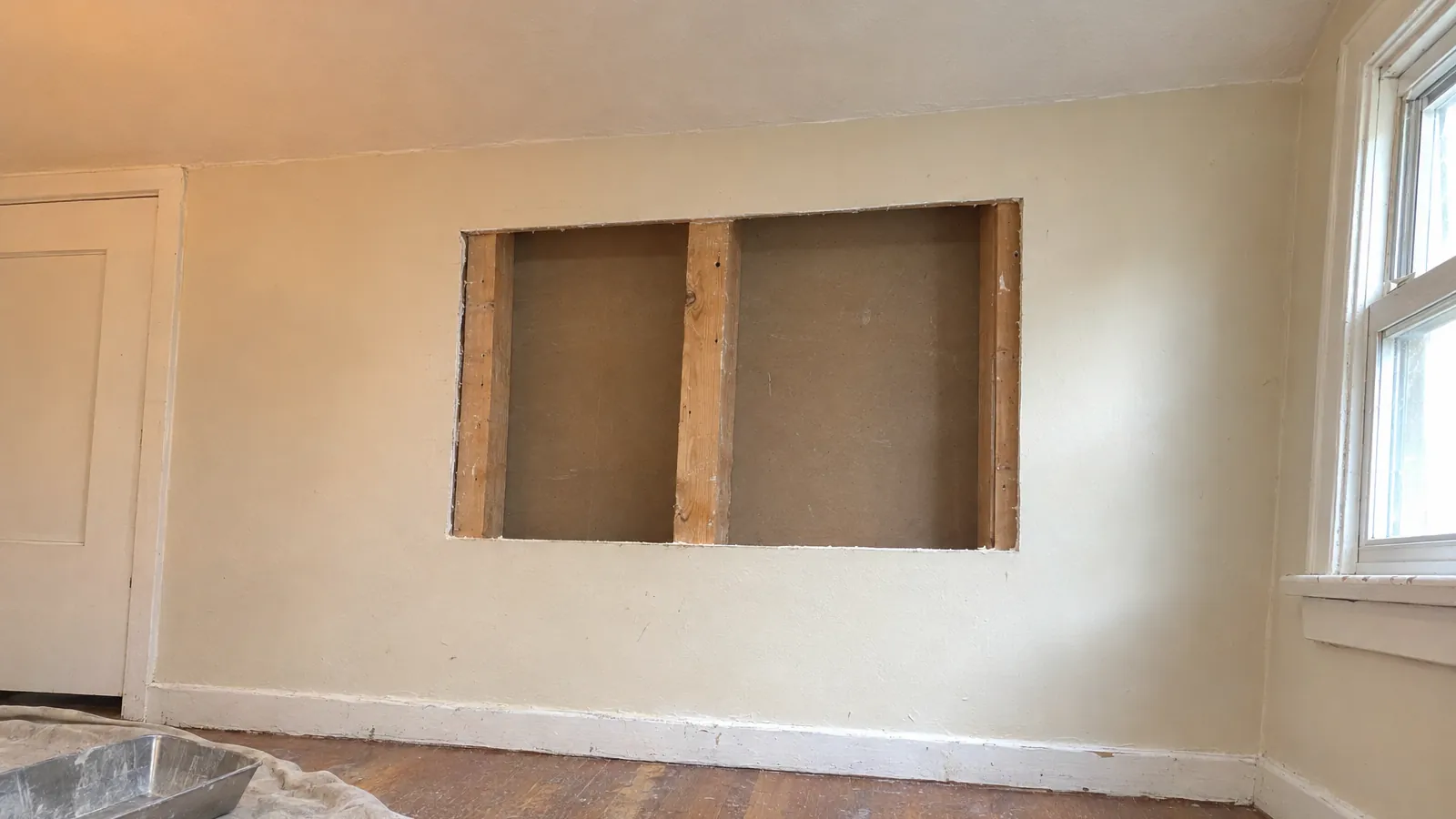
Ice dam ceiling repair in Columbia HeightsOpenings after other work
Openings left by an electrician, plumber or window installer, closed and blended in.
Patching after other trades in Columbia HeightsHoles, dents and pops
Doorknob holes, dents and rows of popped fasteners, patched and sanded flat.
Hole and nail pop repair in Columbia Heights
Some damage keeps getting worse. Some doesn't.
Timing: what should be handled soon, what can wait
Soon
- A ceiling that bulges or holds water
- Start at the panel: cut the circuit to the closest ceiling light or fan. Next, empty the room underneath, and call once nobody is standing below.
- A stain that is still growing
- If the ring spreads or feels damp, water is still getting in. The source gets stopped first. The drywall comes after.
- A crack that widens
- Especially one that shows up with a door that suddenly binds. It is worth a look before anything is filled.
When it suits you
- Fine plaster cracks that return each winter
- Annoying, rarely urgent. Spring is a calm time to tape them, once the heat is off.
- Nail pops and small dents
- Cosmetic. They fit neatly into the next paint job.
- Holes from the electrician or plumber
- Wait until the electrician or plumber is finished. Then close everything at once, before paint.
One tap opens the form with it filled in.
First step: name the problem
Choose what you're looking at. The next page holds the rest of the form, and nothing is sent until you press send.
- Cracks in plaster or drywall
- Ceiling stain or sag
- Hole, dent or nail pop
- Patch after other work
- Something else
Unsure what it is? The last button works too. A short description is plenty.
National figures, not a local price list.
Cost: what makes a repair bigger or smaller
Every wall gets priced on its own. A handful of things move the number.
As a rough yardstick, a national cost guide from This Old House (updated June 2026) puts a small patch by a pro at roughly $60 to $200, a crack at roughly $60 to $330, and a hole in a ceiling at roughly $320 to $1,300.
Those are national ranges, not prices for Columbia Heights. Your number comes from the local pro once they know the wall.
- Size
- A nail hole and a half sheet are different jobs. Larger openings need new board and more coats.
- Ceiling or wall
- Working overhead takes longer, and light rakes across a ceiling.
- Plaster or drywall
- Plaster often has to be reattached and built up to its old thickness.
- Texture
- Smooth walls are simplest. Matching an old sand or knockdown finish takes extra passes.
- Moisture
- Wet board waits until it is dry, and the cause of the water comes first.
- Paint
- Spot priming is usual. Repainting a full wall so the sheen matches is a separate choice.
Some jobs need only a putty knife.
On your own: where a home fix stops making sense
A nail hole or a shallow dent is a fair weekend job. Spackle, a flexible knife, light sanding, a dab of paint.
A hairline crack in drywall is doable too, if you tape it. Filler by itself usually reopens right where it was.
Beyond that, the work gets harder to hide. These are the signs to hand it off:
- A hole wider than your palm.
- Plaster that moves when pressed, or sounds hollow when tapped.
- Anything overhead, especially a textured ceiling.
- A stain you can't trace to a leak that is already stopped.
- A patch that has to disappear on a wall lit from the side.
Can't tell where your wall falls? A short call settles it.
Average lows at the airport, 1991–2020.
Freeze and thaw: how the year shows up on walls
At Minneapolis–Saint Paul International Airport, the average low sits below freezing from November through March.
March and November are the swing months. The average high is above freezing and the average low below it, so snow on a roof can melt by day and refreeze at night.
That is how ice dams build. In University of Minnesota Extension's terms, ice forms along the lower edge of the roof and blocks the melt above it, which can then find its way into ceilings and walls.
Upper rooms under a sloped ceiling deserve a look each winter. Extension lists the slanted part of a ceiling and knee wall spaces among the places heat escapes into the roof.
Heating season also dries the house. In older plaster that tends to show as fine cracks at door corners and along the ceiling line.
Summer runs the other way: humid air, and tape that lifts in a bathroom without a working fan.
The south edge of Anoka County, and just past it.
Coverage: the Heights plus six neighbors
Columbia Heights sits at the south end of Anoka County. Minneapolis is right across its southern border.
Hilltop, a small city surrounded on every side by Columbia Heights, is included. So are Fridley to the north and west, and St. Anthony and New Brighton to the east.
Spring Lake Park, beyond Fridley, and Northeast Minneapolis, to the south, round out the area.
A rough guide, not a diagnosis.
Symptoms: reading the marks
Most wall and ceiling damage falls into a few patterns. Find yours, then read the page that covers it.
For more depth, the reading on walls and ceilings goes further.
| What you see | Likely cause | Read about |
|---|---|---|
| Thin diagonal cracks from door or window corners | Framing movement and seasonal drying | corner and plaster cracks |
| A straight crack where wall meets ceiling | Seasonal truss movement or a failing seam | the ceiling problems guide |
| A tan ring overhead | Water from above: an ice dam, roof or bath | stained ceilings after ice dams |
| Paint that bubbles or peels | Moisture held behind the surface | drying out a wet ceiling |
| Round bumps in a straight row | Nails or screws backing out of the framing | nail pops and small holes |
| Square cuts near outlets, pipes or windows | Access openings from other trades | closing access cuts |
Price first, work second.
Next: one call, or one short form
Say what broke, and in which room. A photo helps; a sentence will do.
We take it from there and book a local pro to price the repair.
Expect a callback: a local drywall pro talks the damage over and sets the quote.
Or text a snapshot to this number
Curious how it all runs? How a repair goes from call to paint.